
Here's what we know about you.
You travel to understand. Not to collect destinations, not to prove you've been somewhere, not to sit by a pool and forget the week - but to feel the connective tissue between the present and the past, between your life and the larger story of the world. You come home from a trip asking different questions than the ones you left with. That's the point.
If that's your travel why, then Southeast Alaska might be the most underrated destination you’ll visit.
Not because of the glaciers - though the glaciers are extraordinary. Not because of the wildlife - though you'll see things that will stay with you for years. But because the cultural and historical layers in this corner of the world are dense, complex, and genuinely worth your time. Alaska has been shaped by Indigenous nations who have lived here for ten thousand years, by Russian imperial ambitions that left their mark on the landscape and the architecture, by a gold rush that drew 100,000 people into some of the most inhospitable terrain on Earth in less than two years.
That is a lot of story to be standing in the middle of.
Here's how a Current traveler approaches it.
Who the Current Traveler Is
Before we go further: if you haven't taken our cruise personality quiz, that's where this starts. The quiz identifies your travel why - the underlying reason you seek out new places - and helps us match you to the experience that's actually going to feed that.
The Current traveler's why is meaning through context. You want to understand the world more deeply than a headline allows. You want to feel connected to something larger than yourself. The history isn't background noise for you - it's the whole point.
Alaska, approached the right way, is a Current traveler's dream. But it requires a specific kind of intention. A lot of mainstream Alaska cruises are structured around the scenery, which is valid - Glacier Bay is genuinely one of the most beautiful places on Earth. But the scenery alone will leave you a little hungry if you're wired the way Current travelers are wired. What fills that hunger is the story underneath the scenery, and that requires seeking it out.
Here's how.
The Tlingit and Haida: Ten Thousand Years Before the Ships Arrived
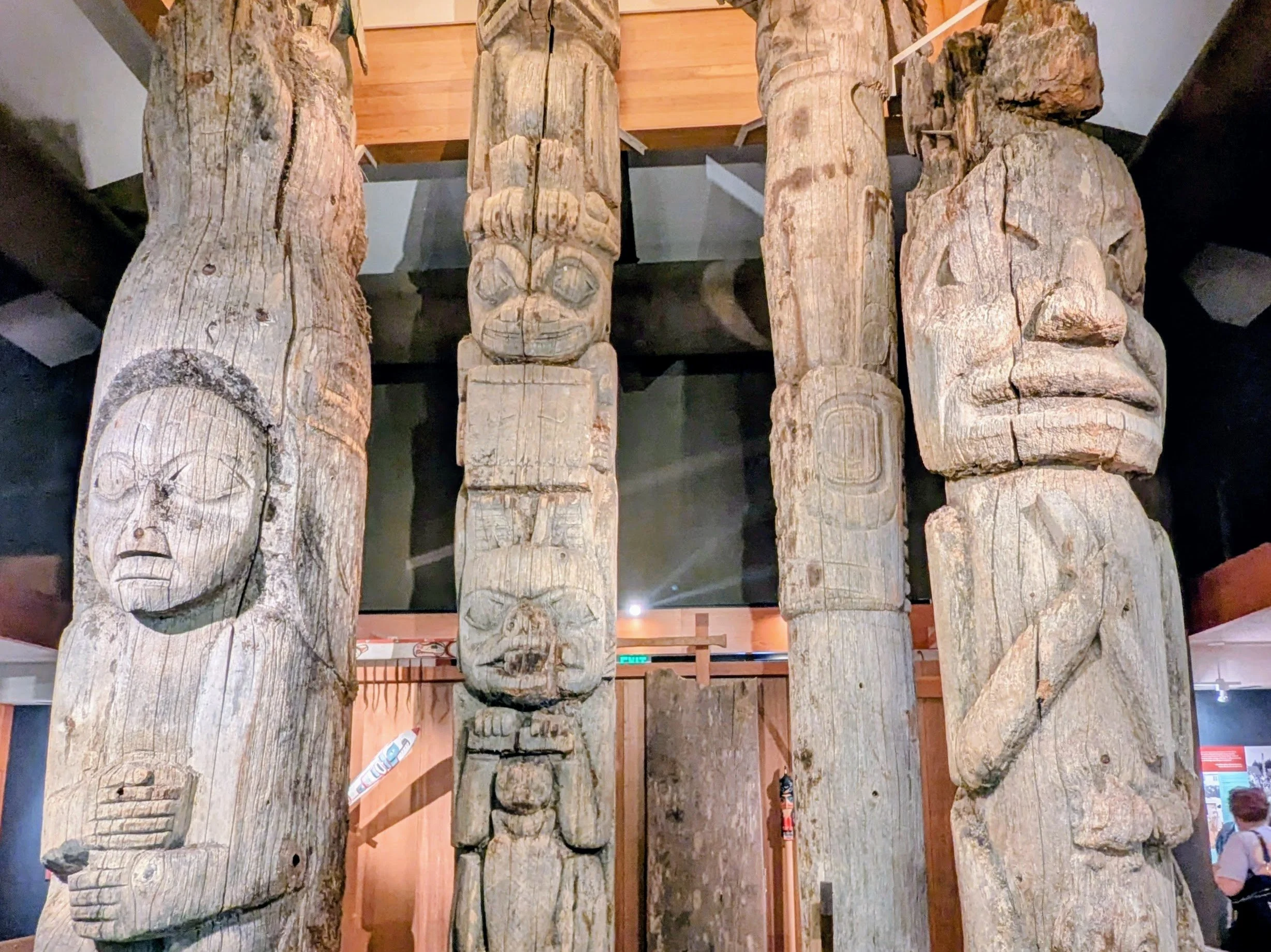
The most important thing to know before you sail Southeast Alaska is that you are traveling through the ancestral homelands of the Tlingit and Haida peoples - nations with deeply sophisticated cultures, complex clan structures, and an artistic tradition that ranks among the most remarkable in the world.
The totem poles you'll see in Ketchikan and Klawock and Sitka and Juneau are not decorations. They are records - clan histories, supernatural narratives, family lineages, and significant events encoded in cedar. Each figure means something specific. The raven, the eagle, the bear, the killer whale - these are not mascots. They are clan identifiers and spiritual beings in a cosmological system that has been elaborated over generations.
Ketchikan is one of the best places in Southeast Alaska to encounter this tradition with real depth. Totem Bight State Historical Park features a reconstructed Tlingit clan house and a collection of restored poles, and the rangers there are knowledgeable. Saxman Native Village, just south of Ketchikan, is an active Tlingit community with the largest collection of standing totem poles in the world and cultural tours led by community members themselves - people who carry this tradition forward as living culture, not museum exhibit.
For Current travelers: Book the Saxman tour. Not the walk-past - the guided cultural experience. The difference between standing in front of a totem pole and having someone whose family carved it explain what it means is the difference between looking at text and being able to read.
Our Picks:
The Haida presence is strongest on Prince of Wales Island - Klawock and Hydaburg are Haida communities, and the newer port at Klawock is an Indigenous-owned facility developed in partnership with local corporations. If your itinerary includes Klawock, read our port day post before you go. The short version: book a shore excursion. This is a port that rewards having a local open it for you.
In Juneau, the Alaska State Museum has a serious Tlingit collection - clan objects, ceremonial regalia, detailed historical context - and is genuinely worth an hour of your time even if you have limited port time. It won't compete with a live cultural experience, but it adds significant depth.
Sitka: Where Russia Left Its Mark on America
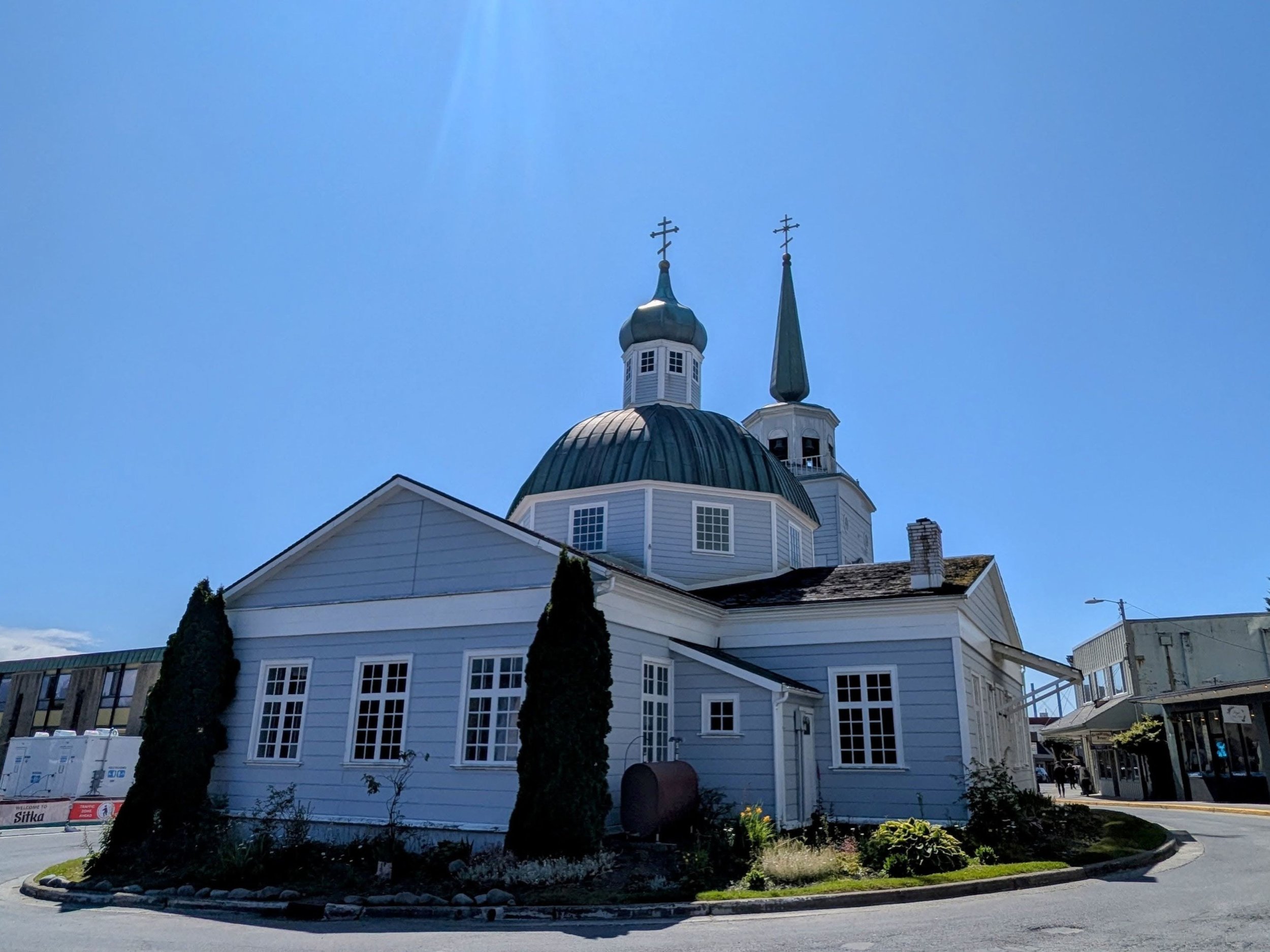
If you have even a passing interest in imperial history, colonial encounter, or the way cultures collide and leave traces on each other, put Sitka at the top of your Alaska itinerary.
Sitka was, for much of the 18th and 19th centuries, the capital of Russian America - New Archangel, as the Russians called it. The Russian-American Company, under Alexander Baranov, established a trading empire here based on sea otter fur, with consequences for the Tlingit who had lived in the area for millennia and for the ecology of the entire North Pacific.
The physical remnants of that history are still standing.
St. Michael's Cathedral sits in the center of downtown Sitka - an onion-domed Russian Orthodox church that has been part of the Sitka skyline since 1848. (The current building is a faithful 1976 reconstruction after the original burned, but the icons and treasures inside are original, rescued from the fire by the townspeople who formed a human chain to pass them out the doors.) The Russian Bishop's House, a National Historic Landmark, is one of the oldest intact Russian buildings in North America and is now a National Park Service site with guided interior tours.
Sitka National Historical Park tells the story of the 1804 Battle of Sitka - the last major armed resistance of the Tlingit against Russian expansion - with thoughtful attention to both sides of that conflict. The park's totem poles, displayed in a rainforest setting along the Indian River, are among the most beautifully situated in Alaska.
For Current travelers: Give yourself time to sit with this. Sitka rewards slowness. The Russian history is fascinating, but what makes it genuinely meaningful is understanding it in relationship to the Tlingit history - the two threads are braided, not sequential. The National Park Service site does this well. The Cathedral does this well too, if you go inside and look at what survived.
One thing to know: Sitka is a small, walkable city, and you can cover a lot of this ground on foot. The downtown corridor from the Cathedral to the Russian Bishop's House to Castle Hill - where the transfer of Alaska from Russia to the United States took place in 1867 - is a short walk and a remarkably dense historical experience.
Our Picks:
Alaska Storytellers - Sitka
Explore Beyond the Dock: Unforgettable Private Tour in Sitka
Skagway: The Gold Rush and What It Reveals About America
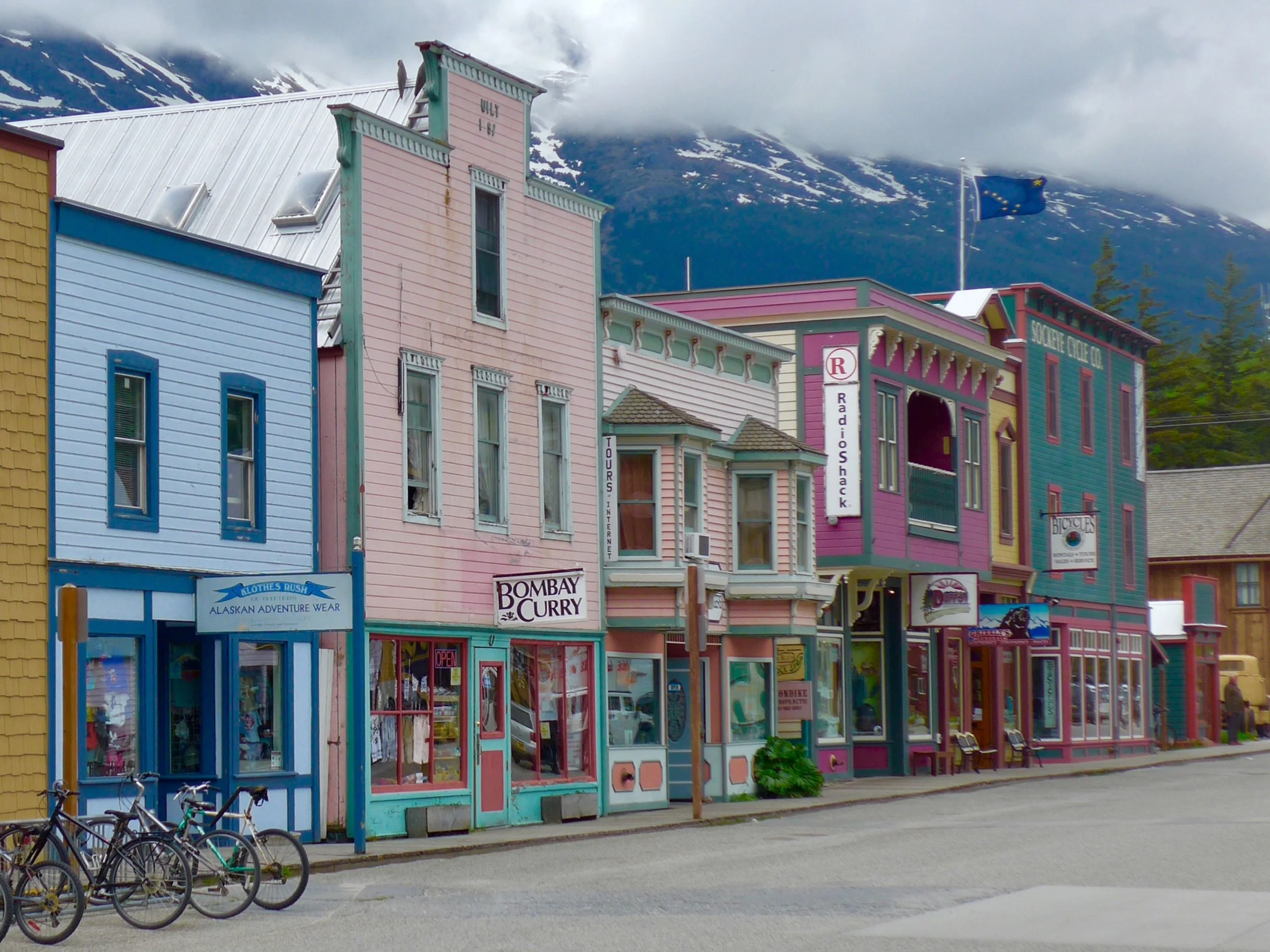
Image courtesy of Canva Pro
The Klondike Gold Rush of 1897-1898 is one of the most extraordinary episodes in American history - a full-scale human stampede into the wilderness, triggered by the discovery of gold in the Yukon, that drew 100,000 people north in under two years.
Skagway was the primary gateway. From here, stampeders climbed the White Pass or the Chilkoot Trail, often in brutal conditions, hauling the 2,000 pounds of supplies the Canadian authorities required before they'd let anyone cross the border. The trails are still there. The stories are still there. The gold, mostly, was not - by the time most people arrived, the best claims were already staked.
What happened in Skagway is a story about American optimism and delusion in almost equal measure: 100,000 people convinced that this time, the riches would be theirs. Most went home broke. Some died. A very small number struck it rich. The whole episode lasted about two years before the rush burned itself out.
Skagway today is a National Historic Landmark district - Broadway Street is lined with restored 1890s buildings, and the Klondike Gold Rush National Historical Park visitor center offers genuinely good historical context. The White Pass & Yukon Route Railroad is a legitimate historical experience: the narrow-gauge railway was built in 1898 to service the stampede and climbs through some of the most dramatic scenery in Southeast Alaska while telling the story of what happened here.
For Current travelers: Take the train. Not because it's scenic - though it is - but because the ranger narration on the White Pass route is genuinely excellent. The story of the construction alone is remarkable: thousands of workers, blasting through granite in the middle of winter, building a railroad in 26 months. The train gives you the landscape and the story simultaneously.
If you're interested in the darker threads - the con men, the lawlessness, the story of Jefferson Randolph "Soapy" Smith (Skagway's most notorious criminal, who built a shadow government in town before he was shot in 1898) - the park rangers are excellent sources. Don't just walk the street. Ask questions.
Glacier Bay: The Story Underneath the Ice
We know. You're a Current traveler. You want meaning, not just scenery. But hear us out on Glacier Bay.
The story of Glacier Bay is one of the most remarkable ecological narratives in the world - and when you understand it, the scenery becomes something different.
Two hundred and fifty years ago, Glacier Bay didn't exist. The entire area was buried under thousands of feet of ice. Then, in what geologists describe as one of the fastest glacial retreats ever recorded, the ice began pulling back - and has been retreating ever since. The Tlingit people who had been displaced by the original ice advance returned and watched the bay emerge from the glacier. The explorer George Vancouver found the area nearly solid ice in 1794. By 1879, when John Muir arrived, the glaciers had retreated 48 miles. Today they've retreated much further still.
You are watching, in real time, the aftermath of one of the most dramatic landscape transformations in recorded history.
The National Park Service rangers who come aboard at the park entrance are worth finding and talking to. The ranger narration during the Glacier Bay day is not background noise - it's the interpretive layer that turns spectacle into story. Ask about plant succession, the return of the Huna Tlingit, the rate of glacial retreat. These are not small questions.
For Current travelers: Glacier Bay is not a detour from meaning. It is one of the most instructive conversations between human history, Indigenous history, and natural history that exists anywhere in the world. Come prepared to listen.
A Note on Ships
We said at the top that you don't need a river cruise to have a meaningful Alaska experience as a Current traveler, and we mean it.
Current travelers often gravitate toward river cruising - and for good reason. The format is built for cultural immersion: small ships, port-intensive itineraries, local guides, historical depth at every stop. That's the experience. But river cruises, by definition, require a river. Alaska requires something different.
The good news: small ship ocean sailing in Alaska delivers the same things you love about river cruising, translated into a different geography. Lines like Azamara and UnCruise Adventures build itineraries that are port-intensive and culturally focused, with smaller vessels that can access places the big ships can't reach. Azamara's Alaska sailings emphasize overnight stays in port - so you're not watching Sitka from the tender line, you're there when the town exhales in the evening. UnCruise goes even further into remote Southeast Alaska, reaching smaller communities and Indigenous-owned ports like Klawock that most itineraries skip entirely.
If you're newer to ocean cruising and want to ease in, mainstream lines like Holland America and Princess call at Ketchikan, Sitka, Skagway, and Juneau - the ports with the densest cultural and historical content. The ships are larger, the experience is broader, but the history is still there waiting for you in port. What you do with your time ashore is entirely up to you.
The framework is the same whether you're on a 50-person UnCruise vessel or a 2,000-passenger Holland America ship: the meaning is in the ports. Know what you're looking for before you get there, and Alaska will deliver it.
What to Book Before You Go
A few specific recommendations for Current travelers building out their Alaska port days:
Ketchikan: The Saxman Native Village cultural tour. Block two to three hours. Don't skip it for something that moves faster.
Sitka: Build in time for both the Russian Bishop's House (NPS) and Sitka National Historical Park. They're not far apart and together they give you the full colonial encounter story. Add the Cathedral if you have the time.
Skagway: The White Pass & Yukon Route Railroad for the historical narration. Supplement with a visit to the Klondike Gold Rush National Historical Park visitor center if time allows.
Glacier Bay: Find the ranger. Ask questions.
Juneau: The Alaska State Museum for Tlingit cultural context and gold rush history. Pair it with the Mount Roberts Tramway - Goldbelt Heritage Foundation runs a Tlingit cultural center at the top that goes well beyond the view. If you have extra time, St. Nicholas Russian Orthodox Church in the historic downtown is easy to miss and worth not missing: the oldest original church in Alaska, with an active Tlingit congregation, it sits quietly on a side street while most visitors walk past.
If you want to explore further, our Southeast Alaska inspiration guide is a great starting point - curated films, videos, and context that bring the region to life before you even board a ship.
Questions about building a Current traveler Alaska itinerary? Talk to us. This is exactly what we love to think through.
Some links in this post are affiliate links. If you book through them, we may earn a small commission - at no extra cost to you. We only recommend experiences we'd book ourselves.