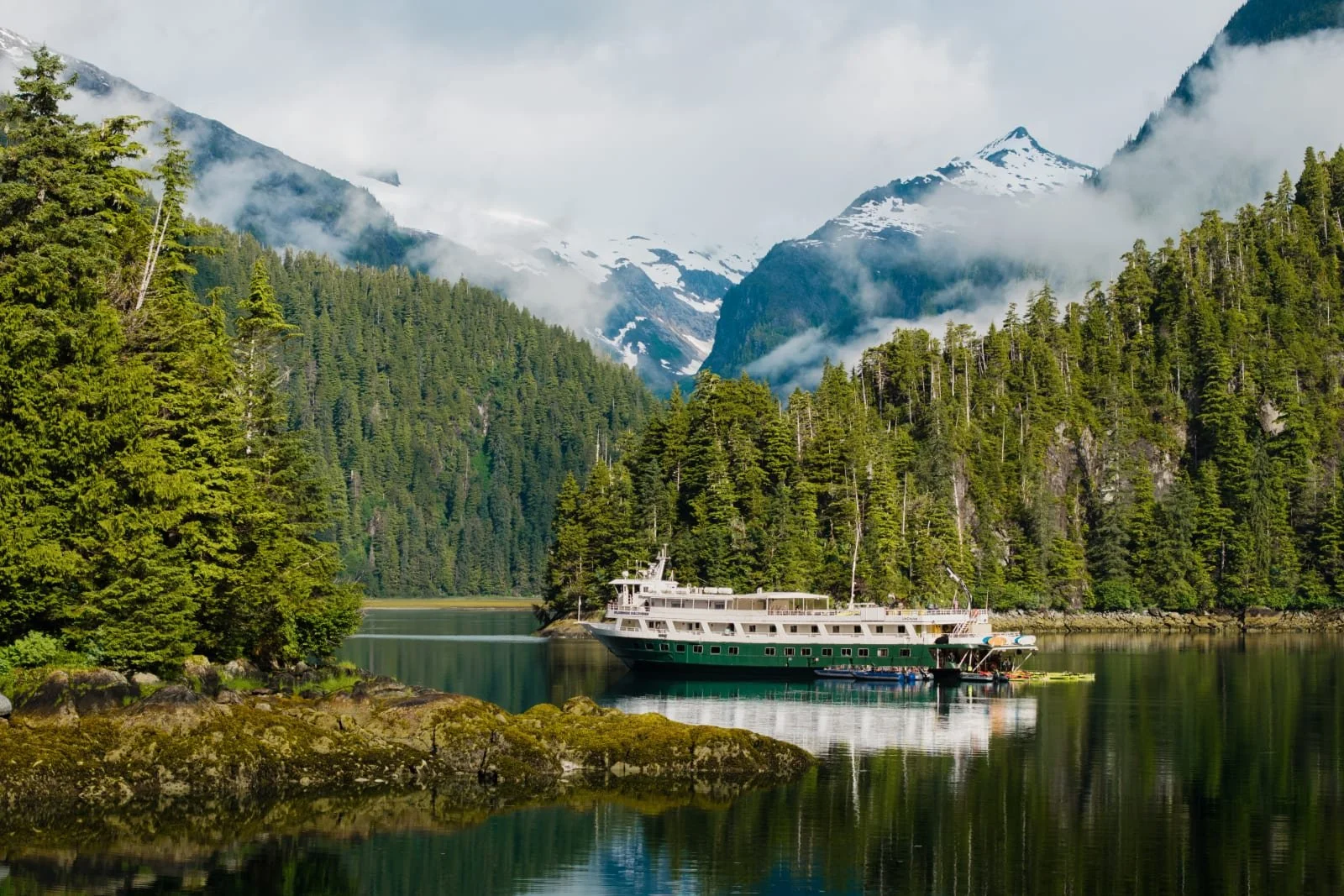
Image courtesy of our partners at UnCruise
There's a version of Alaska you see from the deck of a large cruise ship: glaciers at a distance, wildlife through a zoom lens, ports full of jewelry stores and whale watching booths. It's genuinely beautiful. It's also - if we're being honest - managed.
And then there's the other Alaska.
The one where your ship anchors in a cove with no name on most maps, and you climb into a Zodiac at dawn to paddle toward a glacier that no road reaches. Where a brown bear works the tide flats two hundred yards off your port side and nobody needs to explain why you're all standing perfectly still. Where the ship has fewer than a hundred people on it, and dinner conversation turns to what everyone saw that day, and you realize you haven't thought about your inbox in forty-eight hours.
That's the Alaska the Meridian traveler comes for.
Not a vacation. A recalibration. Proof, in landscape form, that the world is still larger and more alive than your daily life would suggest.
Who Is the Meridian Traveler?
The Meridian traveler doesn't travel to relax. They travel to feel genuinely awake - to stand somewhere that confirms the world is bigger and more remarkable than it seems from the inside of ordinary life.
They're the person who, when offered a choice between a scenic overlook and a trail to get there, takes the trail. Who books the excursion described as "challenging" and reads it as a selling point. Who isn't looking for luxury as an end - but absolutely expects quality, expertise, and the logistical competence that lets them focus on the experience instead of managing the trip.
The Meridian traveler doesn't want a brochure version of Alaska. They want Alaska to reveal itself - on its own terms, at its own pace, without the guardrails.
What they need: a small ship with genuine expedition capability, a naturalist team that actually knows what they're looking at, itineraries that go where the bigger ships can't, and the flexibility to follow the wildlife, the weather, and the unexpected.
That's what this guide is for.
Why Alaska Is Meridian Territory
Alaska is one of the last places in North America where you can travel and genuinely feel like you got somewhere.
The Inside Passage - the network of channels, fjords, and island waterways that runs from Puget Sound to Southeast Alaska - is mostly accessible only by boat or floatplane. There are no roads to most of it. The communities that exist along it are small and have been there a long time: Tlingit, Haida, and Tsimshian peoples have lived and fished these waters for thousands of years. The landscape itself is the story.
From a small expedition ship, you can reach places that simply don't exist in the experience of a standard Alaska cruise:
Remote bays and fjords with no other boats, no signage, no infrastructure - just the water, the mountains, and whatever's living there
Tidal flats and estuary systems where brown and black bears work the shoreline at low tide, close enough that you're counting the details
Glaciers accessible only by Zodiac or kayak - not slow-cruised past at a respectful distance, but approached
First-contact-style wildlife encounters - humpbacks, orcas, Steller sea lions, harbor seals, Sitka black-tailed deer - without a narrated excursion boat full of two hundred people
The weather in Southeast Alaska is famously variable and doesn't apologize for itself. The Meridian traveler tends to find this a feature, not a bug.
The Right Ships for Meridian Travelers in Alaska
This is where the difference lives. The ships that serve the Meridian traveler in Alaska are fundamentally different in size, mission, and ethos from the large cruise lines. Here's where to look.
UnCruise Adventures is, for Alaska specifically, the name we come back to first. Based in the Pacific Northwest, their small ships - typically 22 to 88 guests - are purpose-built for the Inside Passage, with shallow drafts that allow exploration in coves and inlets the bigger vessels can't approach. Their expedition team is exceptional: naturalists, wilderness guides, and cultural interpreters who have spent seasons in Southeast Alaska and know what they're looking at. The itineraries reach places that most Alaska cruise passengers never see - remote bays, tidal flats, hidden anchorages that require local knowledge to navigate.
The style is genuinely expedition: Zodiacs in the morning, kayaks when conditions allow, a flexible daily schedule that follows what's actually happening in the natural world rather than a port list printed months in advance. The onboard experience is warm and competent, not stiff - communal meals, open wheelhouse access, the kind of ship culture that develops when you're a small group sharing something real. Alaska is where UnCruise is best in the world, and it shows.
Hurtigruten Expeditions (HX) (the expedition branch, distinct from the original Norwegian coastal route) brings an authentically expedition-focused approach shaped by decades of Arctic and Antarctic travel. Their naturalist and expert program - scientists, researchers, local specialists - is among the most credible in small ship travel. On Alaska itineraries, this translates into on-deck interpretation that adds real context to what you're seeing: the ecology, the cultural history, the glaciology. The ships run toward the modern and well-equipped side, without sacrificing the expedition character that defines the brand. A strong choice for travelers who want intellectual rigor alongside the wilderness experience.
National Geographic Expeditions × Lindblad brings the weight of the National Geographic brand to bear in exactly the way you'd want: genuine scientists and photographers leading the expedition team, a culture built around observation and documentation, and an onboard approach that treats guests as curious adults rather than passengers to be managed. Their Alaska programs have long been considered benchmark-quality, and the combination of expedition capability and journalistic attention to the natural world gives the trip a specific texture. For the Meridian traveler who also has a strong lens-on-the-world sensibility - who wants to come home with not just the experience but the ability to see and describe it - Lindblad is worth a close look.
Ponant sits at the intersection of expedition and understated luxury - the French small ship line known for polar and expedition itineraries, is now operating in Alaska. The ships are elegant, the expedition programming is serious, and the ratio of intimacy to geographic reach is what distinguishes it. If the Meridian traveler in question also has Zenith tendencies - high aesthetic standards, real attention to the quality of the experience - Ponant is where those two personas meet.
What a Meridian Alaska Itinerary Actually Looks Like
No two days are the same, and that's the point. But here's a sense of what the experience looks like when it's working.
You're anchored somewhere in the northern Inside Passage. The ship has maybe sixty people on it. At 6 am, a naturalist gets on the PA - not with an alarm, but with a calm, specific announcement: brown bear on the port beach, two cubs, working the tide line.
Half the ship is on deck in five minutes.
The bears are doing what bears do. They don't acknowledge the ship. The tide is out and the flats are rich, and they're focused. The cub behavior is different from the mother's - quicker, more exploratory, less efficient - and the naturalist next to you explains, quietly, what that developmental difference means. You stand in the cold for forty-five minutes and don't feel the cold.
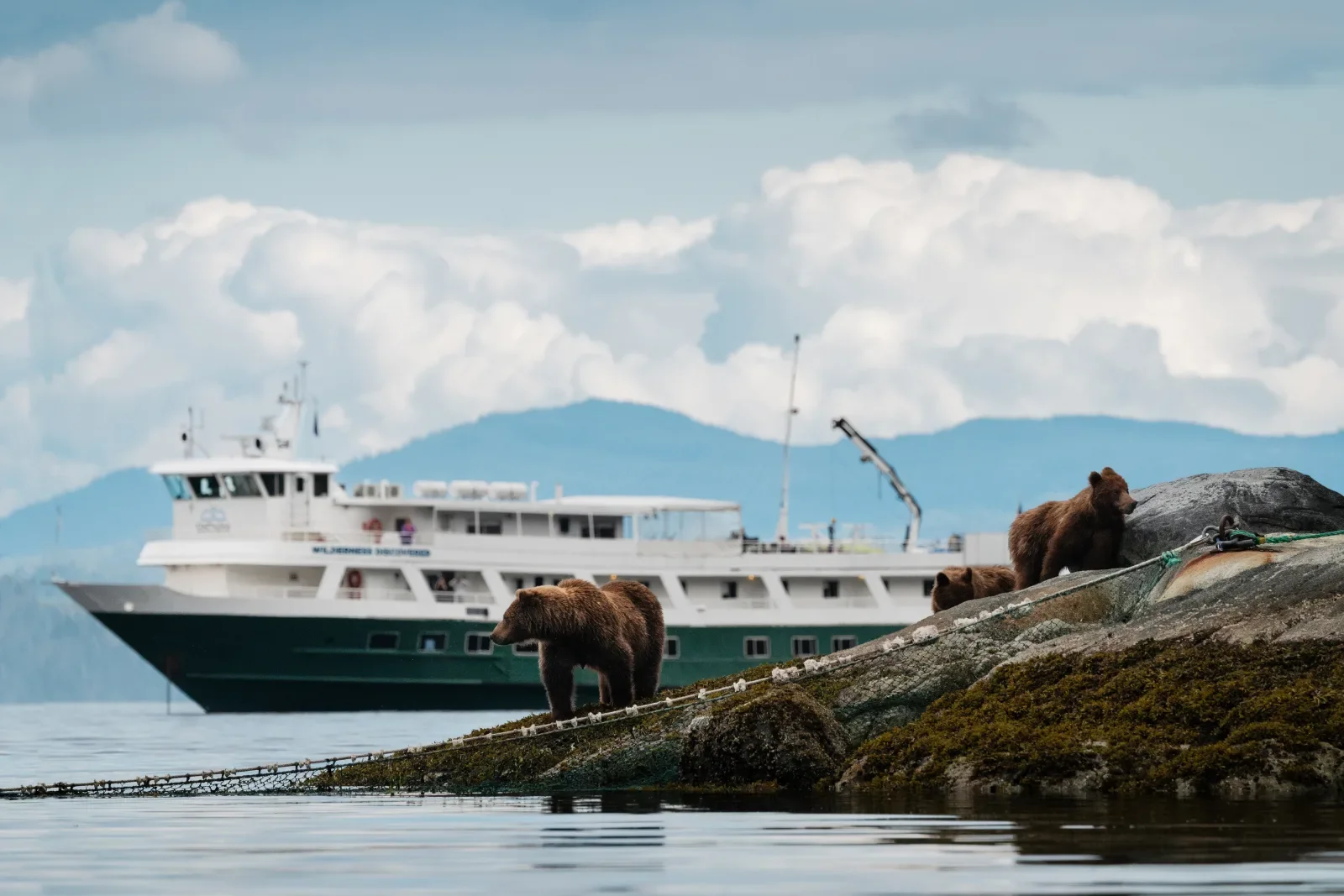
Image courtesy of our partners at UnCruise
Then breakfast.
Then Zodiacs to a glacier that isn't on any of the main cruise line itineraries - not because it's unknown, but because getting there requires a shallow-draft vessel and local knowledge of the channel. You drift in close enough to hear the ice working. Calving is unpredictable: sometimes nothing happens for an hour; sometimes a column of ice the size of a small building breaks off and the water around you rearranges. Your guide knows how close is close enough.
In the afternoon, conditions permitting, kayaks are launched from the stern platform. You paddle toward the glacier face. The scale of it doesn't fully register until you're in it.
That night, dinner is communal, the conversation is real, and someone shows photographs on the shared screen. Tomorrow the ship moves. The schedule will adapt to what's there.
That's the trip.
Expedition Experiences Worth Knowing About
The specific activities that define an Alaska expedition cruise for Meridian travelers tend to be the ones that require small ships to access:
Zodiac excursions are the basic unit of expedition travel in Southeast Alaska - small, inflatable craft that launch from the ship and allow access to beaches, glaciers, and wildlife areas the ship itself can't approach. Most expedition ships launch Zodiacs multiple times daily when conditions permit.
Kayaking from the ship - not a kayak excursion from a port, but launching from the vessel itself into an anchorage that may have no other human presence — is one of the distinctive experiences of small ship Alaska travel. Paddling toward a glacier or along a forested shoreline with nothing but the sound of water is its own kind of recalibration.
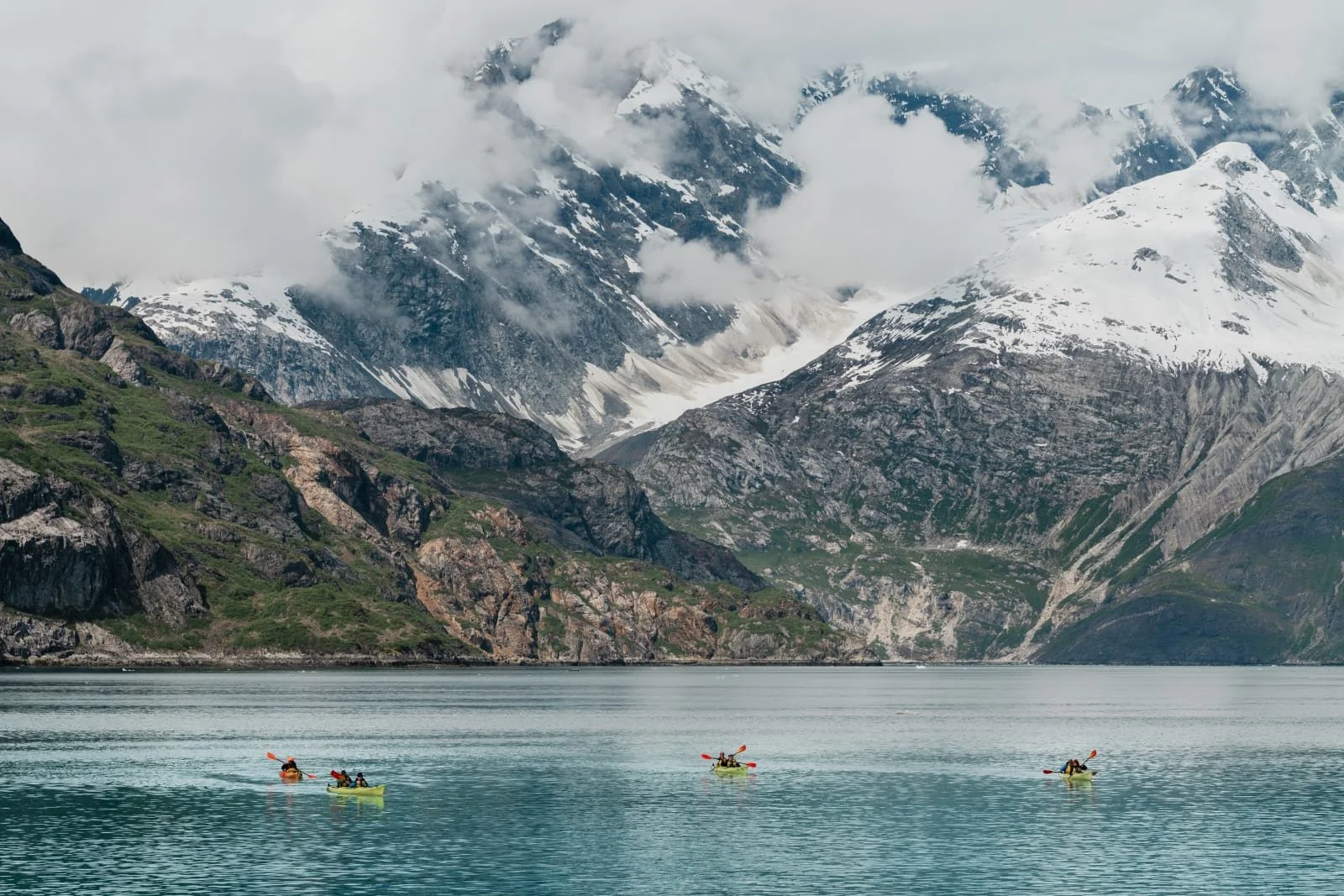
Image courtesy of our partners at UnCruise
Bear viewing on tidal flats is something Southeast Alaska does better than anywhere. Brown bears concentrate along the salmon-rich streams and tidal zones, particularly in late summer, and from a small ship at anchor in the right bay, the encounter is direct and unhurried - not a tour bus stop, not a platform, just the water between you and a functioning ecosystem.
Whale encounters in Alaska tend to be sustained in a way that shorter excursion boats can't match - particularly humpback bubble net feeding, which requires patience and positioning to witness. Expedition ships can hold position and follow behavior in ways that larger vessels can't. Seeing a group of humpbacks execute a coordinated bubble net feeding from a Zodiac at close range is the kind of experience that does something to how you think about the word "intelligence."
Cultural and archaeological sites - abandoned Tlingit village sites, totem poles returned to the forest, middens and longhouse foundations - are part of the Southeast Alaska landscape and are often interpreted on expedition itineraries by cultural guides with genuine knowledge and standing. This layer of the trip distinguishes the best expedition programs from purely wildlife-focused ones.
When to Go
Alaska's peak season runs mid-May through mid-September, with the core summer months (June, July, early August) offering the longest days and highest wildlife activity. Late July and August bring the salmon runs, which concentrate bears and eagles along the streams in ways that are spectacular for wildlife viewing.
For Meridian travelers who prefer fewer people and can tolerate more variable conditions, late May and early June offer a compelling alternative: lush green landscapes, minimal crowds, calving glaciers actively at work from winter snowfall, and the particular quality of light in a northern late spring. The shoulder season suits people who aren't looking for perfect weather - they're looking for real weather.
A Note on Booking
Expedition Alaska - particularly UnCruise and Lindblad - books significantly earlier than large-ship itineraries. The ships are small, the departures are limited, and the travelers who know what they're looking for tend to reserve a year or more in advance. If Alaska is on your list for 2027 or 2028, this is not a trip to leave until spring of the travel year.
It's also - genuinely - a trip worth spending time thinking through with someone who knows the ships. The differences between lines and itineraries are meaningful: some go further north, some are better for kayaking, some have stronger cultural programming, some are more appropriate for travelers with specific physical considerations. The Meridian traveler tends to have strong preferences once they know what to compare. Getting that right before you book is the whole point.
Ready to Find Your Alaska?
Not sure if you're a Meridian traveler? Take our cruise personality quiz - it takes five minutes and will tell you exactly what kind of traveler you are, and which ships and destinations are built for your style.
If expedition Alaska is already calling, let's talk about it. These programs book early, and the conversation is worth having sooner rather than later.
Still in the research phase? Our Southeast Alaska Approach Guide covers the destinations, the ships, and the shore experiences in depth.