Your First Cruise Is to Alaska. Here's What We Want You to Know.
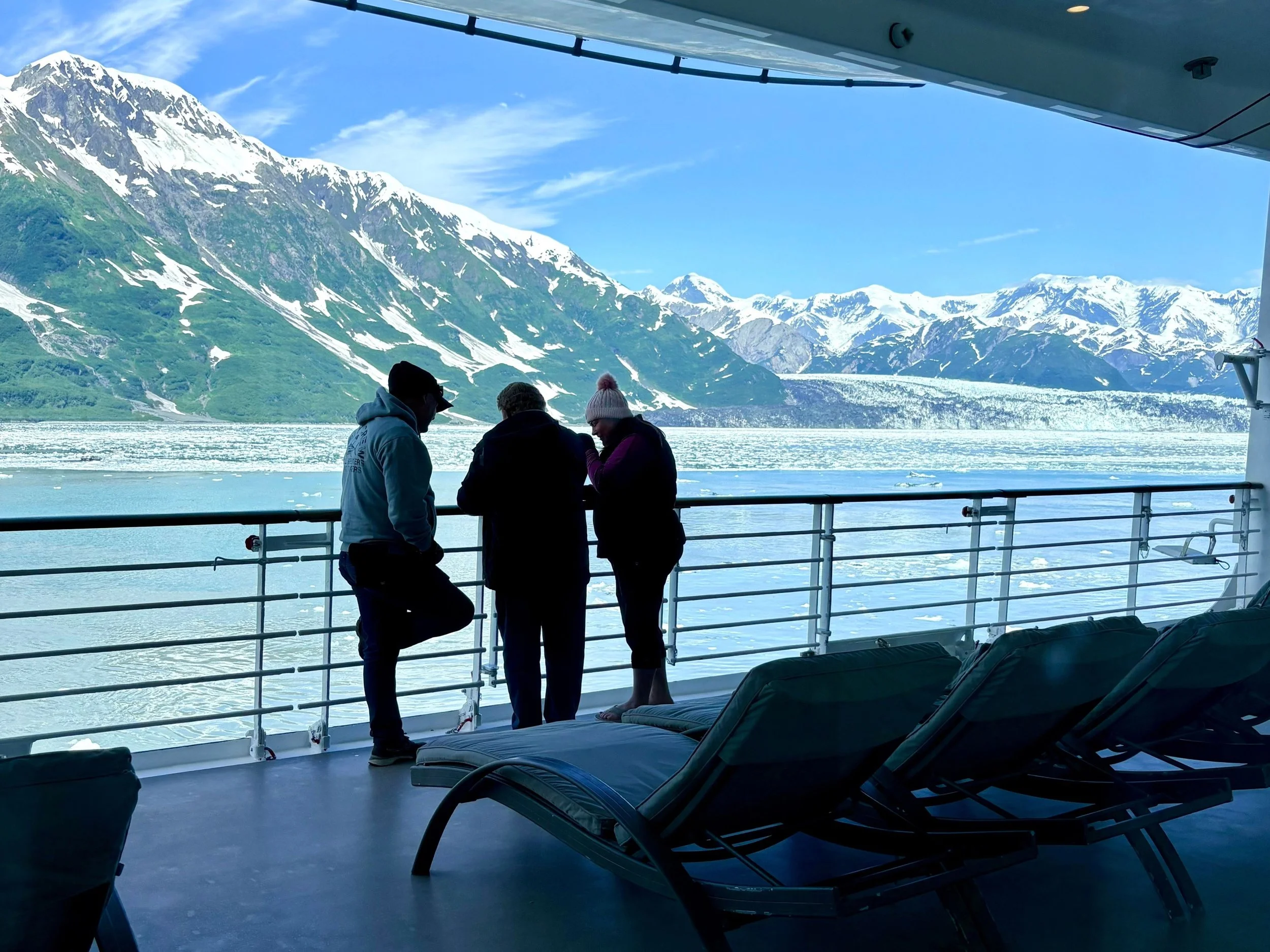
You made an interesting choice.
Most people take their first cruise somewhere warm - the Caribbean, the Mediterranean, somewhere with a beach and a fruity drink waiting on the other end of the gangway. You picked Alaska. Which tells us something about you: you're not looking for easy. You're looking for something.
That's exactly why we love working with first-timers who choose Alaska. And it's also why we want to make sure you're prepared - not over-prepared, not anxious-prepared, but ready in the way that lets you actually be present for what's about to happen to you.
Here's what we tell every first-time sailor before they set sail north.
Before You Leave Home
Complete your online check-in early - like, 30 to 45 days early.
Every major cruise line has an online check-in process, and it matters more than most people realize. You'll upload your passport photo, fill out health forms, and - importantly - print your boarding pass before you arrive at the pier. Travelers who skip this step spend their first hour in a line. Travelers who do it in advance walk right on.
Set a reminder on your phone for 45 days before departure. Do it over coffee. It takes twenty minutes.
Download the cruise line's app before you board.
This is one of those tips that sounds like a "nice to have" and is actually a "non-negotiable." The app is how you see the daily schedule, message travel companions without cell service, and make dining reservations. Most cruise line apps work entirely without a data plan once you're connected to the ship's Wi-Fi - which means you won't accidentally rack up a satellite roaming bill just trying to find out what time trivia starts.
(We'll say more about that bill in a moment.)
Book your excursions before you go. Not "eventually." Now.
Alaska excursion availability is not like the Caribbean. The whale watching tour in Juneau that fits perfectly in your port window? It might be gone by February if you're sailing in June. The floatplane flightseeing in Ketchikan, the white-water rafting outside Skagway, the glacier hike in Juneau - these book up months in advance, and the best operators reach capacity quickly.
A couple planning their Alaska cruise waited until a few months out to book a Resurrection Bay cruise — one of the most spectacular wildlife experiences in the region. By the time they tried to reserve it, it was sold out. They ended up with a shorter alternative that was still lovely, but it wasn't what they'd been looking forward to. Book early. We mean it.
Ask us which excursions are worth prioritizing. That's what we're here for.
What to Pack (The Alaska Edition)
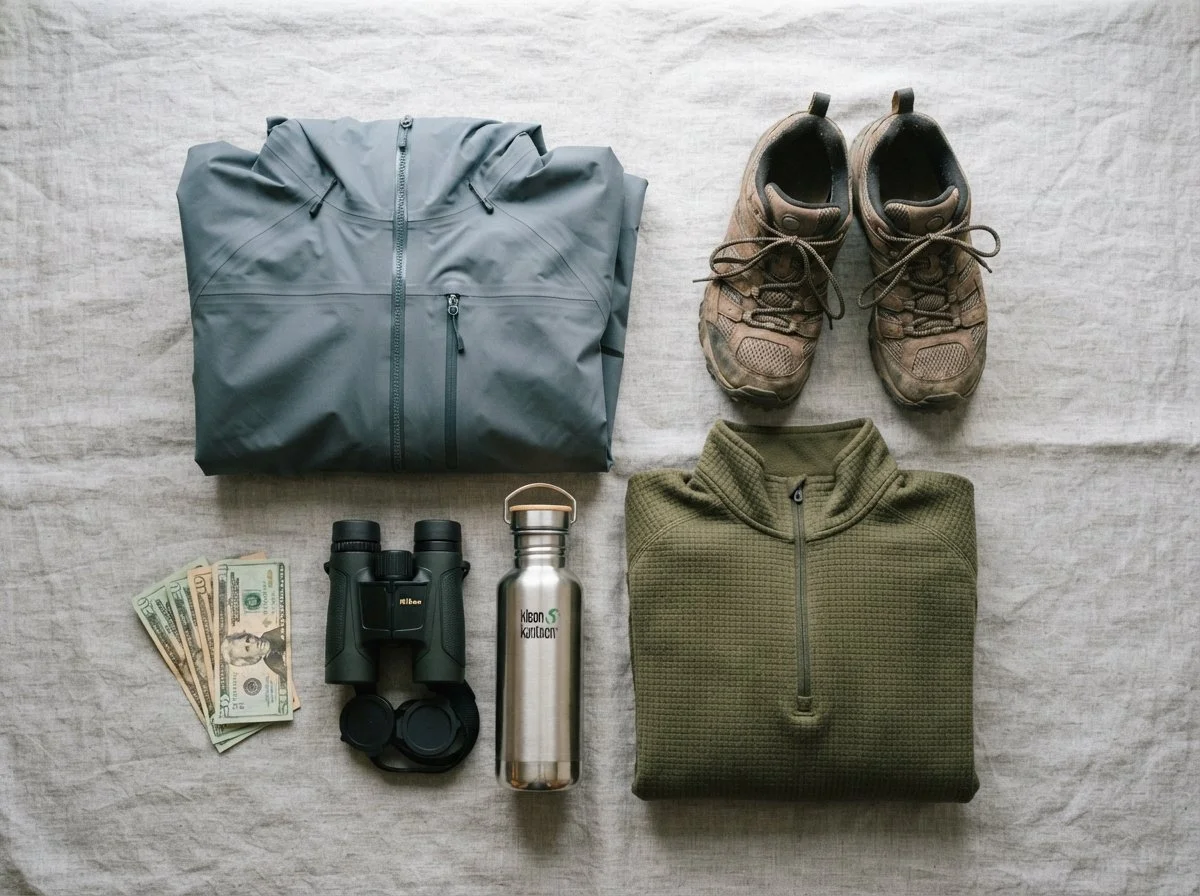
Packing for an Alaska cruise is different from packing for anywhere else - and most first-timers either overpack the wrong things or underpack the right ones.
The thing everyone underestimates: layers.
Not just "bring a jacket." Bring a base layer, a mid-layer fleece, and a waterproof outer shell - and plan to wear all three at once on glacier days. Alaska weather changes fast. You can be in a t-shirt in Sitka and in full rain gear two hours later. The travelers who are comfortable all day are the ones who can add and shed layers on the fly.
The thing everyone overpacks: shoes.
One pair of sturdy, broken-in walking shoes. One pair of something slightly nicer for evenings (a loafer, a flat, a clean sneaker - really, anything that isn't a hiking boot). That's it. Cruise ship floors are not rough terrain. Port towns in Alaska are small and walkable. You don't need five options.
The thing almost nobody thinks to bring: binoculars.
Even a cheap pair from Amazon will change your glacier days, your whale watching, your time on deck as you navigate the Inside Passage. You'll be watching for humpbacks and black bears and bald eagles - all of which you can spot from the ship if you know what to look for. Binoculars make it real in a way your phone zoom simply can't.
A few other things worth mentioning:
Rain gear, not just an umbrella (wind makes umbrellas useless on deck)
Refillable water bottle (ship water is fine; you'll go through a lot of it)
Small bills in USD for port tips and local vendors
Your travel documents in your carry-on, not your checked luggage
Medications in your carry-on, full stop
What not to bring: power strips (fire hazard, confiscated at pier), irons or steamers (available onboard), or more than you can comfortably carry through an airport. Your room key is your onboard wallet. You don't need to carry much.
Embarkation Day
Arrive at your assigned time.
We know it's tempting to show up early. Everyone shows up early. Which is exactly why the pier is chaos between 10am and noon. Your cruise line assigned you a check-in window for a reason - if it says 1:30pm, arrive at 1:30pm. You'll walk onto the ship faster than the people who "tried to beat the crowd" at 10.
Your cabin probably won't be ready until around 2pm.
If you've checked your larger bags at the pier, you'll just have your carry-on with you - which is totally manageable. And here's a tip not enough people know: the main dining room is sometimes open for lunch on embarkation day for a few quiet hours, before the ship fills up. It's far less chaotic than the buffet and worth checking on your ship before you default to the Lido deck.
Do the muster drill. Take it seriously.
It's mandatory, it's not optional, and on modern ships it's usually done through the app rather than standing on a hot deck for an hour. It takes fifteen minutes and tells you where to go in an emergency. Just do it.
Lock in your dining reservations on day one.
If your ship has specialty restaurants, the best tables go fast - sometimes within hours of boarding. Get the app open, find the dining section, and make your reservations before dinner on night one. This is especially true for sea days, when everyone wants to try something different. Or, even better - do it on the app before you even board!
How to Think About Port Days in Alaska
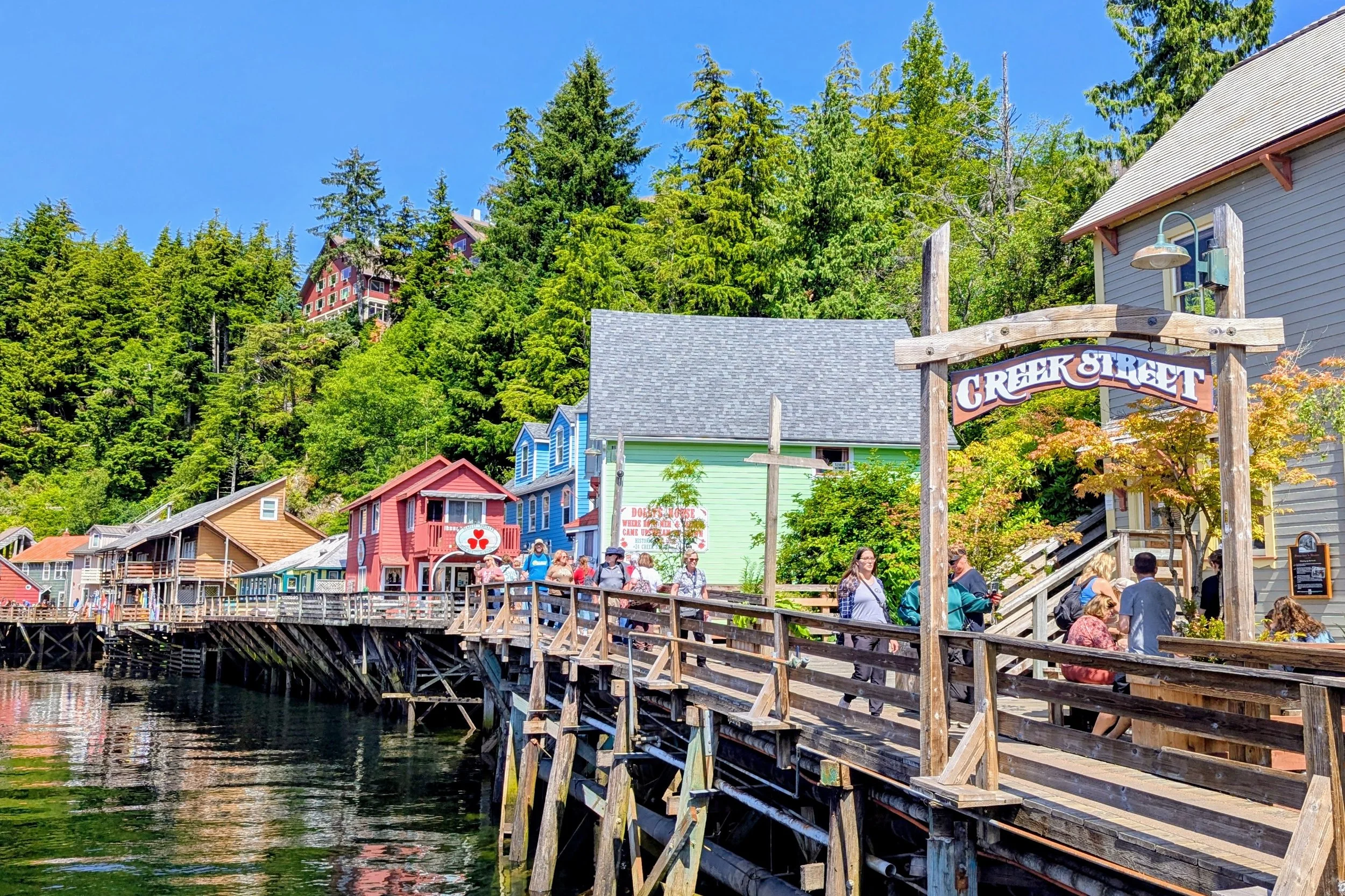
Here's the advice we give every single first-timer, and it's the one they thank us for most:
One well-chosen excursion per port. That's it.
The instinct, especially when you've spent real money to get to Alaska, is to maximize. Do the whale watching and the glacier hike and the floatplane and still get back to town for salmon chowder in a bread bowl. We understand that instinct. We've had it ourselves.
But here's what actually happens when you over-schedule a port day: you spend the whole day watching a clock instead of watching Alaska. You're rushing from the whale boat to the shuttle to the glacier trail - and you're exhausted and slightly resentful by the time you get back to the ship.
Alaska port towns are small. Skagway has about a thousand residents. Sitka is the same size as a neighborhood. You cannot actually do everything - and once you stop trying to, you'll discover that one unhurried excursion, followed by an hour of wandering the main street, is more satisfying than three rushed ones.
We've seen this work beautifully in Ketchikan: do the free salmon walk through town, wander a few of the local neighborhoods, grab lunch at a local restaurant, and catch The Lumberjack Show in the afternoon or evening. That's a full, satisfying port day - and nobody was rushed.
A few port day logistics worth knowing:
Bring your ship card (your ID and wallet on the ship) and a government-issued photo ID to every port
Know your ship's all-aboard time - it's usually one hour before the ship departs, and it is not a suggestion. The ship will leave without you.
Ship time and port time are not always the same. Check the daily newsletter and the app, not just your phone's local time.
Sunscreen and a refillable water bottle matter, even when it's overcast
A Few Things We Always Tell First-Timers (But Especially Alaska Ones)
Turn on airplane mode when you're at sea.
Satellite roaming is the most common surprise on a first-timer's cruise bill. Your phone will search for a signal, find a satellite, and rack up charges you didn't intend to authorize - all while sitting in your pocket. Turn airplane mode on when you leave port, connect to the ship's Wi-Fi for what you need, and check your bill at guest services around day three to make sure nothing unexpected is running.
You don't have to do everything.
There will be trivia at 3pm and a cooking demonstration at 4pm and a comedian at 9pm and a late-night buffet at midnight. The daily newsletter is not a to-do list. It's an options menu. The part that first-timers forget to plan for - and remember most - is the unscheduled hour on the deck with a book while a fjord passes by.
Alaska will do its best work on you when you give it some room.
If you love this trip, book your next cruise before you disembark.
Booking onboard almost always comes with the best available perks: onboard credit, reduced deposits, first access to new itineraries. If Alaska has already made you a convert - and it usually does - your advisor (hi, that's us) can be reached onboard to help you figure out where to go next.
What Alaska Does to First-Timers
We've watched a lot of people fall in love with Alaska. It tends to happen the same way every time: slowly, and then all at once.
It's usually not the big moment - not the calving glacier or the humpback breach, though those are extraordinary. It's the cumulative weight of being somewhere that is genuinely wild. The morning you wake up and the ship is threading through a passage so narrow you could almost touch the trees on both sides. The afternoon light that stays until 10pm. The silence when the engines slow.
People who come back from Alaska cruises often struggle to explain what happened to them. They say things like "I didn't expect to feel so small" and "I didn't want to look at my phone" and "I'm already looking at next summer."
That's what we're planning for you.
Ready to Go?
If you've already booked your Alaska cruise and have questions about what to prioritize, reach out to us directly - that's what we're here for.
If you're still in the research phase, a good place to start is our Southeast Alaska Approach Guide, which covers the ports, the experience, and what makes Alaska different from everywhere else you could go.
And if you want to understand what Alaska actually feels like before you get there - the sounds, the tastes, the cold air on your face on a glacier morning - this piece will help: Alaska Through Five Senses: What Nobody Tells You Before You Go.
Questions are the whole point of working with an advisor. Ask them.