The Most Radical Thing You Can Do on Vacation Is Put Down Your Phone
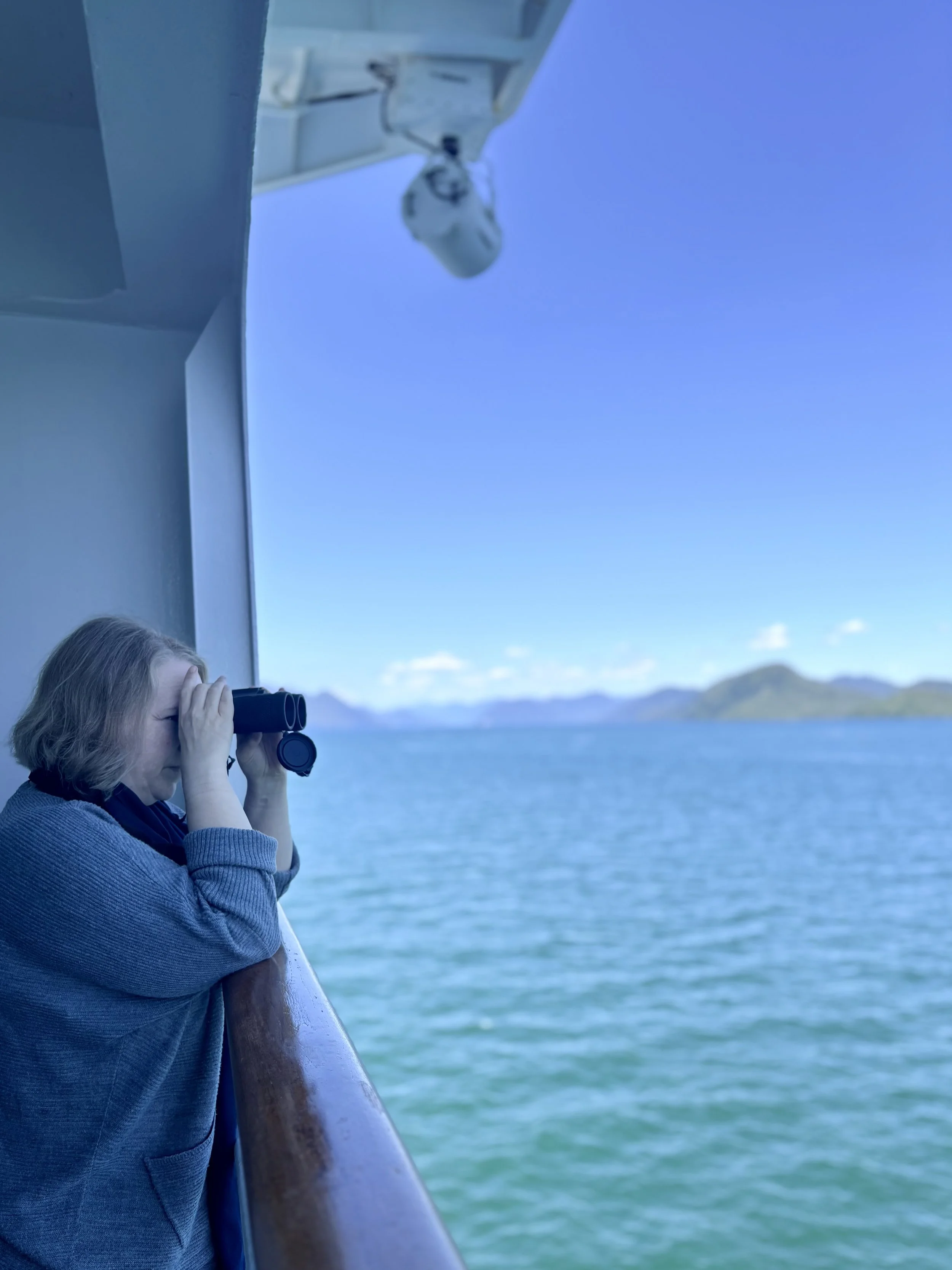
On presence, permission, and the Jellyfish Donut I ate but didn't photograph.
David Chang said it better than I will.
In a recent CNN interview, the chef and restaurateur - a man who has built an empire on making things worth talking about - said this:
"Throw away your phone. I mean, really what's the worst thing that's gonna happen?"
And then: "I've been as guilty as anyone of looking at my phone too much, and I missed the feeling of discovery."
He wasn't talking about Alaska. He wasn't talking about cruises. He was talking about the particular grief of being somewhere extraordinary and not quite being there - because part of you is already thinking about the caption.
I read that and felt seen in the least comfortable way.
The Disposable Camera Problem
Elizabeth and I grew up in an era of film cameras.
You had 24 exposures. Sometimes 36 if you splurged. You pointed, you clicked, and then you had to wait - days, sometimes a week - to find out if you'd captured anything at all. Half the photos were blurry. Some were dark. A few, occasionally, were exactly right.
But here's what we remember most about traveling with a film camera: I was always, completely, there.
We weren’t reviewing what we'd just shot. We wasn't editing in real time. We weren’t composing a story around the experience while the experience was still happening. We weren’t posting and then checking for likes and comments. We took the photo and then We went back to looking. With our eyes. At the amazing and beautiful things in front of us.
The Guardian recently published a piece that made a similar point about sunsets. We've all done it - pulled out a phone, pointed it at something gorgeous, and spent the next three minutes trying to capture light that a phone sensor was never designed to capture. And while we were doing that, the sunset happened. We were there for the documentation. We missed the event.
I think about this a lot. I thought about it constantly in Alaska.
The Jellyfish Donut
I should tell you that I almost didn't get one at all.
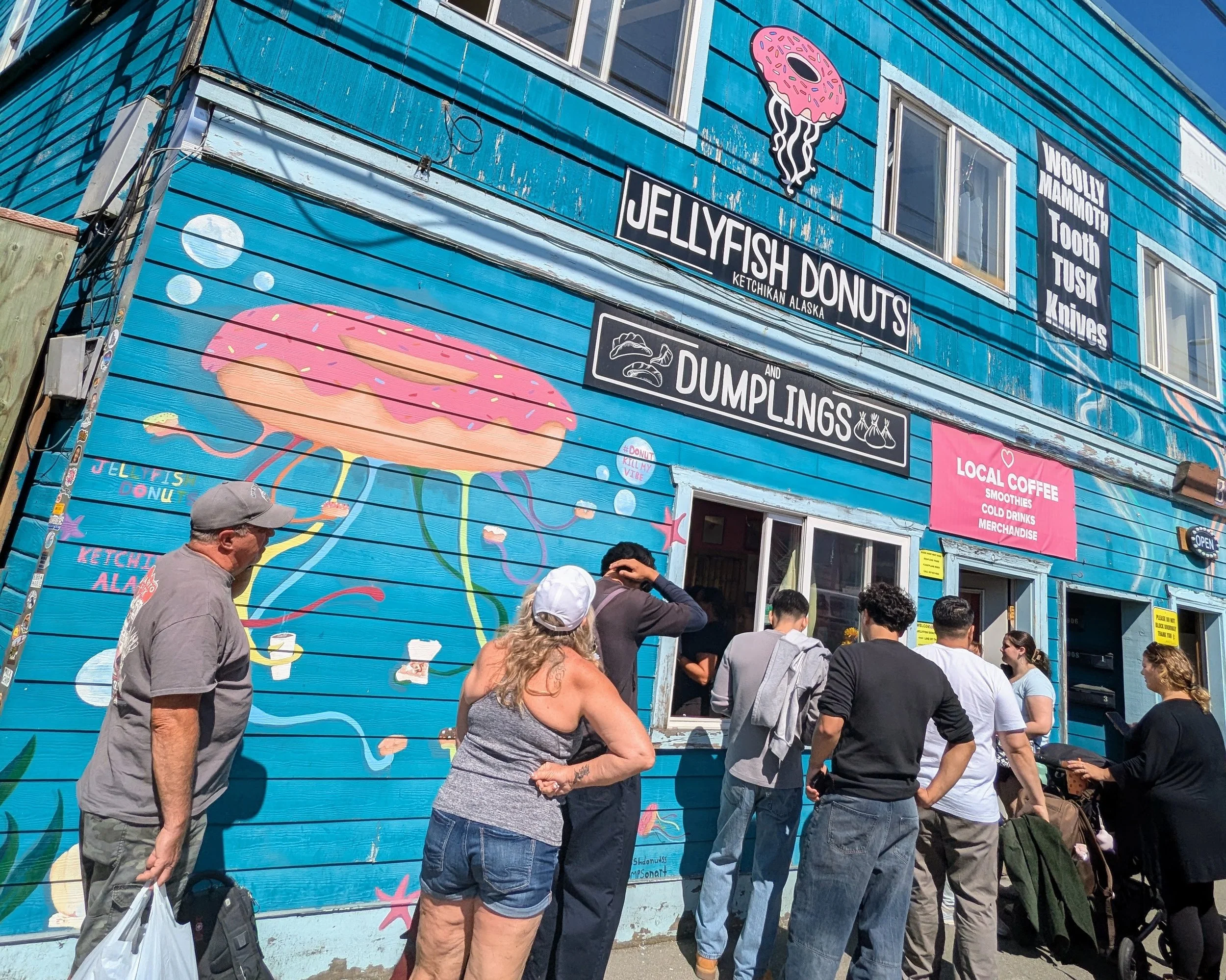
Jellyfish Donuts is one of those quintessential Alaska experiences. Before we docked, we’d made a mental note that we were going to visit. We wandered over in the afternoon. We stood outside. We started discussing flavors. And then someone told us they were done frying for the day.
Turned away. No donut.
So by the time we got to Juneau - where Jellyfish Donuts has a second location - I had history with this donut. I waited in line, taking in the atmosphere of the storefront, studying the flavors the way you study a menu when you know you only get one pick and you're going to mean it. I chose carefully. I pulled it out of the bag when I met my sisters and brother-in-law, and we all dug in together.
The donut was exactly what we were expecting - oversized, loaded with moose tracks toppings, and frosted in a way that made it almost too beautiful to eat. The kind of thing that, in 2026, you photograph before you do anything else. The kind of thing that exists, in part, because people photograph it.
We ate it.
I didn't take a picture first. We just ... ate it. In the middle of a trip that was already overloading my capacity for beauty and wonder, I decided that what I wanted was to eat the donut. Not document the donut. Not share the donut with the world. Just eat it, with my family, in Juneau, on a random afternoon in July.
It was delicious.
And I have no proof. The closest thing I have is a photo of the line in Ketchikan - the donut I couldn't have yet, the anticipation, the storefront. That's it. That's the whole archive.
Here's what I want to tell you: that was fine. More than fine. It was, in some small way, the point.
What Alaska Did to Us
We are (reluctant) content creators. We run a business that depends, in part, on our ability to share experiences in ways that make other people want to have them. There is a real and legitimate tension between being present and being productive - between living the moment and capturing it for the people who weren't there.
We felt that tension constantly in Alaska.
When the humpbacks surfaced thirty feet from the ship, I was so awestruck I couldn't film properly. My hands were shaking. I was laughing. I kept lowering the phone to look with my actual eyes because the phone felt like it was getting in the way of something that was happening to me, not just near me.
I have okay footage of that. I have a perfect memory of it.
And then there was Hubbard Glacier.
When it calved, neither Elizabeth nor I got it on video. Not because we weren't trying. Because we were too busy seeking out where it had just happened - scanning the face of the glacier, watching for the next place the ice might crack and fall and talking about it with everyone else on the deck - and then trying to be in exactly the right position when it happened again. We were chasing the moment so hard that we forgot to document it. And then it happened again, and we were just ... there. Watching. Stunned.
We have no footage of that. But we also have a perfect memory of it.
Some moments are not for your followers. Some moments are for you.
The Cruise Advantage Nobody Talks About
Here's where we want to make a point that might surprise you coming from cruise advisors.
The structure of a cruise is, accidentally, one of the best environments for being present that we've ever experienced.
Not because you're forced to disconnect. Most ships have Wi-Fi; you can stay as connected as you want. But because the logistics disappear.
On a land trip, part of your brain is always running in the background. Which restaurant tonight? Is that the right train? Did I book the hotel for the right dates? How do we get from here to there? That ambient logistics-anxiety occupies cognitive space - and cognitive space is the same space that presence requires.
On a ship, someone else is running that program. The ship moves; you're already where you're going. The dining options are curated; the decision fatigue is gone. The day's shape is there when you wake up, and all you have to do is show up to it.
What that frees up, we discovered, is attention. Real attention, pointed outward, at the world.
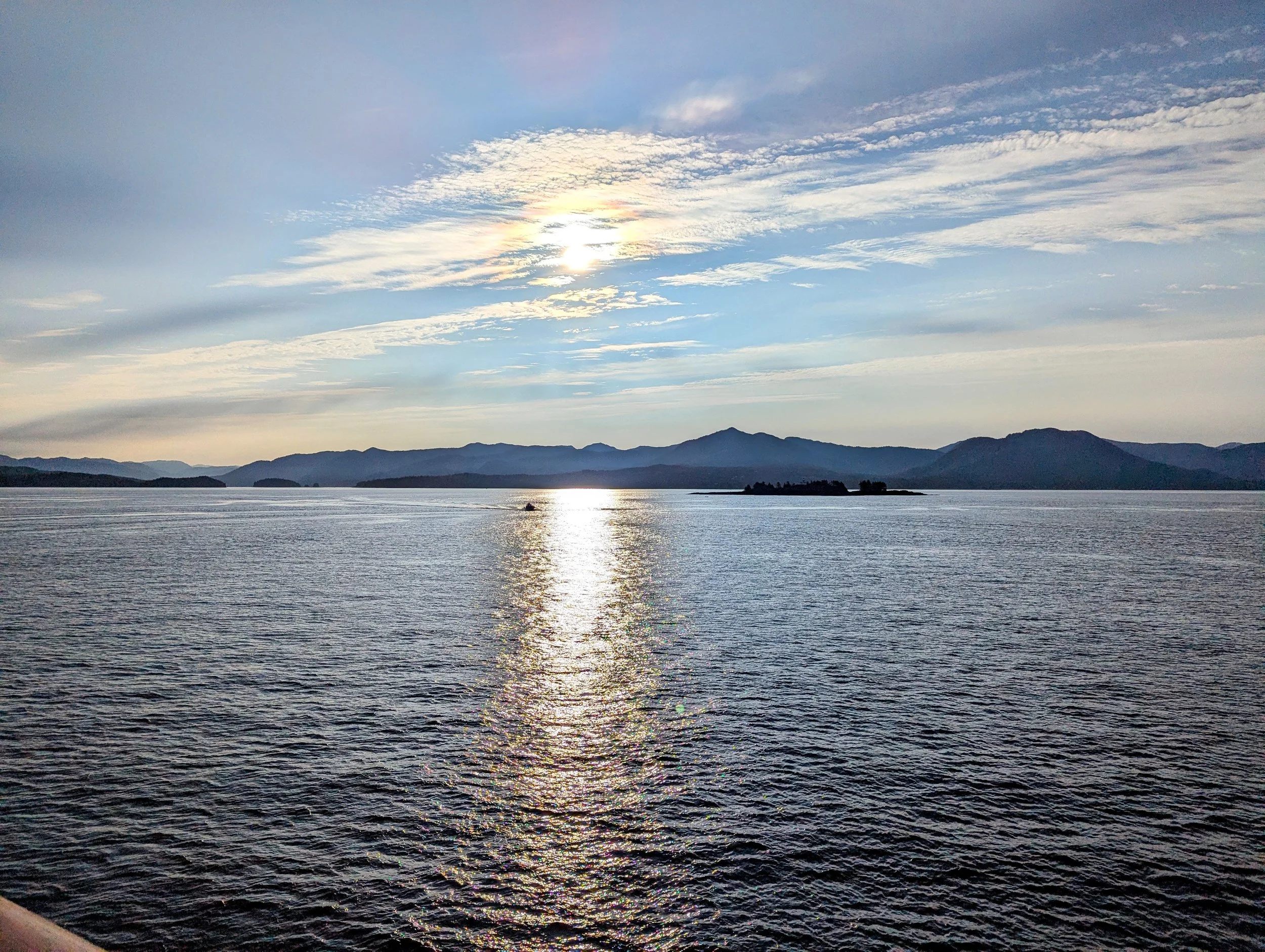
We noticed things in Alaska we’re not sure we would have noticed otherwise. The way the fog moved around the mountains at 6am. The quality of the silence in a forest that has nothing to explain itself to anyone. The feeling of cold air coming off a glacier while something warm was in my hands.
We noticed them because we weren't navigating. We were just there.
Permission
I think what people are craving right now - what David Chang was gesturing at, what The Guardian was writing about - isn't really about phones. It's about permission.
Permission to be somewhere without performing being somewhere.
Permission to eat the donut - and just enjoy it - without photographing it.
Permission to watch the whale breach and not immediately check whether you got it on video.
Permission to have an experience that belongs entirely to you - not to your feed, not to your followers, not to the version of yourself that needs to prove, continuously, that your life is being lived.
That permission is available. You don't have to earn it. You can just decide.
Alaska helped us decide. The structure of the trip helped us decide. The silence helped us decide.
But mostly, I think we were just ready. Ready to stop being the documenter of our lives for a little while and go back to being the ones living it.
The Practical Version
If you're the kind of person who relates to this - and I suspect, if you've read this far, you are - here's what I'd actually suggest.
Pick one moment per day to put the phone away entirely. Not to document the decision to put the phone away. Just to be somewhere, with your senses, for a little while.
Alaska is a good place to practice this, because Alaska is aggressively beautiful in a way that makes the phone feel inadequate anyway. The glacier is better than any photo of the glacier. The silence is something no video can capture. The Pel'meni, eaten standing on a sidewalk, is a perfect sensory experience that belongs exactly where it happened.
Some of the best things in life don't have great footage.
They have you, there, awake, paying attention.
That's enough. That was always enough.
Thinking about a trip where the structure does some of the work for you - where the logistics disappear so the presence can arrive? Start here → or reach out directly. We've been there. We know what it feels like.